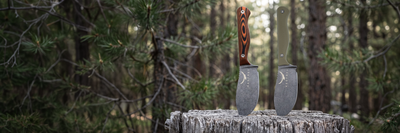
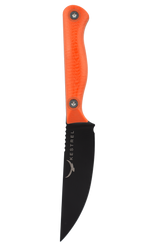


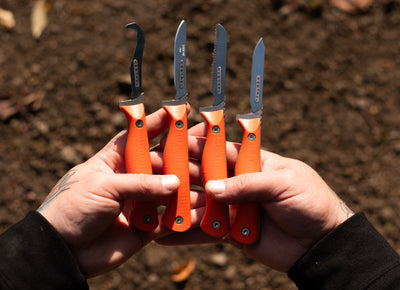
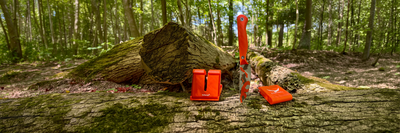


Every replaceable blade knife comes down to two little pieces of steel. Pick the right one and the work goes fast. Pick the wrong one and you're either fighting a blade that's too blunt for the job or babying a sharp tip around a cape you can't afford to nick.
Our Mountain Scalpel 2.0 and Ovis Scalpel 2.0 take the same blades. Both ship with seven of them: five #60A and two #70A. Here's what each one is for, how the A series compares to regular #60 and #70 blades, and how to carry the right mix.

The Short Answer
- 60A: your workhorse. A sharp, pointed blade for skinning, quartering and most of the cutting on any animal.
- 70A: the same thickness and strength with a blunt tip. Use it anywhere a sharp point could punch through something you don't want punctured.
Most hunters run a 60A for the bulk of the work and switch to a 70A for the careful parts. That's why the knives come with more 60As.
The 60A: Strength and Control for the Big Work
The 60A is built for breaking down an animal. It gives you a sharp, dependable edge that holds up under real field use, whether you're skinning, quartering or finishing a long pack-out.
Reach for it when you're:
- Opening up and skinning. The point lets you start cuts cleanly and work the hide off fast.
- Quartering. Separating shoulders and hindquarters, working around joints, and freeing the backstraps.
- Trimming and boning out meat. A fresh 60A makes quick work of clean cuts.
When it starts to drag, don't fight it. Swap in a new one. That's the whole point of a replaceable blade.
The 70A: When the Tip Can't Slip
The 70A carries the same thickness and strength as the 60A, but with a blunt tip that protects the hide from accidental punctures. It's the blade for careful work in tight spots where you still want a clean, smooth cut.
Reach for it when you're:
- Caping. Working around the eyes, ears, nose and lips, where one slip with a sharp point can ruin a mount.
- Working right against the hide. Anywhere you're cutting close and a poke-through would cost you.
- Cutting where you don't want a point at all. If the tip has no job in the cut, the blunt tip just removes a way to make a mistake.

If you plan to cape, read How to Choose a Caping Knife before you go. A lot of hunters pair a 70A scalpel with a fixed blade caper like the Mountain Caper 2.0 for exactly this work.
How Many Should You Carry?
The seven blades that come with your scalpel are a solid start for a hunt. For a longer trip, or if you hope to fill more than one tag, add a pack of Extra Blades in 60A or 70A. They weigh next to nothing, and running out of sharp blades on day six is a bad way to finish a hunt.
A simple rule: carry more 60As than you think you need, and always keep at least one 70A if there's any chance you'll be caping.
Want one handle to do the work of several knives? The Scalpel Kit is the accessory for that. It adds a dedicated guthook and a compact bone or wood saw alongside a 60A and a 70A, so the same Mountain Scalpel or Ovis Scalpel handle covers the animal from start to finish. Swap the blade, and you've essentially turned one knife into four.

A vs Regular #60 and #70 Blades
Regular #60 and #70 blades fit both scalpels too. We ship and recommend the A series (#60A and #70A) because those blades are hardened and last longer in the field. If the shop near camp only has regular #60 or #70, you're not stuck. Put one on and keep hunting.
How to Change a Blade Safely
No pliers needed. Take your time, keep your fingers off the edge, and do it on a stable surface if you can.
- Pinch the blade on the spine. Hold it by the dull back edge with your fingers, never by the sharp side.
- Press up from the bottom. This releases the blade from the lock.
- Slide it off. Ease it forward off the handle and put the used blade somewhere safe, like the empty blade wrapper or a small sharps tin.
- Slide the new blade on until it locks in place, then check that it's seated before you cut.
Pack out your used blades. They're small, sharp, and nobody wants to find one on the trail.
Which Scalpel Handle Fits You?
Both handles take the same blades, so the choice comes down to grip versus grams.
- Mountain Scalpel 2.0: a 12g knife (handle only, no installed blade or sheath) in aerospace-grade titanium. One of the lightest replaceable blade knives on the market, for when every ounce counts.
- Ovis Scalpel 2.0: our Ovis Hunter handle in 6Al-4V titanium with G10 grip surfaces, 2.4 oz (handle only, no blade or sheath). More to hold onto when your hands are cold, wet or tired.
Still deciding? The Knife Model Comparison Guide lays out the whole lineup side by side.

Pair It with a Fixed Blade
A scalpel is at its best next to a fixed blade that handles the heavier work, like the Ovis Hunter 2.0. That's the system we lay out in Best Knife for Elk Hunting. Your fixed blade is covered by Kestrel For Life: a lifetime warranty and free lifetime sharpening, so the steel blade stays sharp while the scalpel blades stay fresh.
Load up the right blades, pack a spare or two, and go get it done.
