



An elk is a lot of animal.
By the time you've skinned it, pulled the quarters, taken the backstraps, gotten the tenderloins and trimmed the neck and rib meat, your knife has done more work than it will on just about any other hunt.
And you're usually doing it miles from the truck, on a slope, with the light going and a long pack-out still ahead of you.
So what's the best knife for elk hunting?
We'll be honest with you. We don't think it's one knife. For most elk hunters, we think it's two.
Here's why, followed by the setups we'd recommend.
What an Elk Knife Actually Has to Do
Before you pick a knife, it helps to think about the jobs you're asking it to do.
On an elk, that list is long:
- Opening the hide without cutting hair into the meat.
- Skinning a big, heavy hide, often one side at a time.
- Pulling quarters, which means working the hip joint and getting under the shoulder.
- Taking the backstraps with long, clean cuts along the spine.
- Reaching the tenderloins without opening the gut.
- Trimming neck and rib meat, where a fine tip helps.
- Caping, if you're keeping a bull for the wall.
Some of those jobs reward a strong, full-size blade. Others reward a small, sharp, precise edge.
That's the whole reason a two-knife setup makes so much sense on elk.
What to Look For in an Elk Hunting Knife
1. A Blade Size You Can Control
Bigger isn't better here.
You don't need a camp knife to quarter an elk. You need enough edge for long cuts and a tip you can actually control when you're working around a joint or along the spine.
A blade that's too long gets in the way. A blade that's too short makes the big cuts slow.
2. An Edge That Lasts
Elk hide is tough, and hair and dirt are hard on an edge.
A knife that starts out sharp and fades halfway through the job turns into a slow, frustrating afternoon. A dull knife also takes more pressure, and more pressure is how slips happen.
That's why most of our hunting knives use MagnaCut. On our MagnaCut models, the edge holds through the entire animal, so you're cutting instead of stopping to sharpen.
If you want the full story on the steel, read MagnaCut for Hunting Knives.
3. Grip When Your Hands Are Wet
A knife can feel great in the living room.
What matters is how it feels when your hands are cold, wet and covered in blood. Look at the jimping, the handle shape and where your fingers naturally land when you choke up.
4. Weight That Earns Its Place
You're about to pack an elk off the mountain, and that usually takes more than one trip.
Your knife isn't what's going to break you. But every piece of gear should earn its place, and a knife setup that's lighter without giving up function is a real advantage on a long hunt.
5. A Sheath You Trust
You'll be climbing, crawling and sitting down hard.
A secure sheath that keeps the knife where you put it matters more than people think. Check how the knife locks in and how you'll carry it.
6. Easy to Keep Sharp
Every knife eventually needs an edge.
Think about how you'll touch it up in the field and how you'll get it properly sharpened after the season.
Our recommendation: don't choose an elk knife on looks or specs alone. Picture yourself on your knees next to a bull at dark, and ask which knife you want in your hand.
Why We Recommend Two Knives for Elk
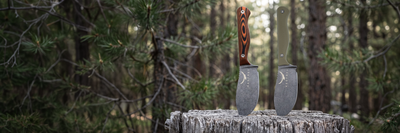
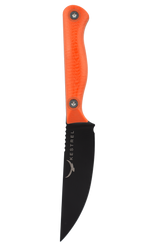
Here's the setup we keep coming back to: a fixed blade for the heavy work, and a replaceable-blade scalpel for the hide and detail work.
The fixed blade does the jobs that need strength. Working the hip joint, getting under the shoulder, long cuts down the backstrap.
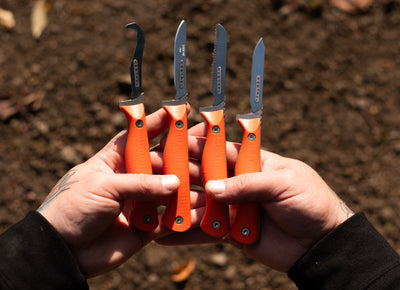
The scalpel does the jobs that need a scary-sharp, precise edge. Opening the hide, skinning, trimming and caping. And when the edge fades, you swap in a fresh blade.
Each knife does what it's good at, and you're not asking one blade to do everything.
It's also a nice bit of insurance. If something happens to one knife, you're not stuck.
The Kestrel Elk Setups We'd Recommend
We build both fixed blades and scalpels, so here's how we'd put them together for elk.
The All-Around Setup: Ovis Hunter 2.0 + a Scalpel
If you want one setup that handles nearly everything, this is where we'd start.
The Ovis Hunter 2.0 is our all-around fixed blade. It has a 4.25-inch MagnaCut blade, a contoured G10 handle, a slight upswept tip and a long belly with plenty of usable edge. That makes it a good fit for quartering, long cuts on the backstrap and controlled work around joints.
Pair it with a Mountain Scalpel 2.0 or Ovis Scalpel 2.0 for the hide work.
The Ovis Scalpel uses the same handle shape as the Ovis Hunter, so you get a fuller grip. The Mountain Scalpel is the smaller, lighter option.

The Ultralight Setup: Ovis Skeleton 2.0 + Mountain Scalpel 2.0
If you're on a backpack hunt and you weigh everything, this is the one.
The Ovis Skeleton 2.0 is a 34g knife (1.2 oz, knife only) with a MagnaCut blade and a paracord-wrapped skeleton handle. It's still a full-tang fixed blade, just stripped down to the essentials.
The Mountain Scalpel 2.0 weighs just 12 grams (handle only, no blade or sheath). It has a 6Al-4V titanium handle, takes 60A and 70A blades and comes with seven of them.
That's about 46g of knife for the whole elk, before sheaths.
You do give up some of the fuller grip of a G10 handle. For a lot of backcountry hunters, that trade is worth it.
The Full Kit: Add a Dedicated Skinner and a Caper
Some hunters want a specific tool for every job.
The Ultralight Hunter Set 2.0 pairs the Ovis Skeleton with a Skeleton Skinner (a 36g knife) and the Mountain Caper 2.0. The Outdoorsman Set 2.0 does the same with the Ovis Hunter, the Mouflon Skinner and the Mountain Caper.

If You're Keeping the Cape
A bull you plan to mount changes the job.
Caping around the eyes, ears, lips and nose is precision work, and that's where a small knife like the Mountain Caper 2.0 (a 19.5g knife) earns its spot. We cover that in more detail in How to Choose a Caping Knife.
What If You Only Want to Carry One Knife?
That's fair. Plenty of hunters do.
If it's one knife, we'd look at the Ovis Hunter 2.0. It's built around versatility: enough edge for big cuts and a fine enough point for detail work.
It won't be as precise as a caper around the face, and it won't give you a fresh edge on demand like a scalpel. But it'll handle the whole animal.
Not sure which model fits how you hunt? Our Knife Model Comparison Guide lays them out side by side.

Don't Forget a Way to Keep It Sharp
Even a great edge eventually fades, especially if you get lucky twice.
A few things worth keeping in the pack:
- Spare scalpel blades. They weigh almost nothing, so bring more than you think you'll need.
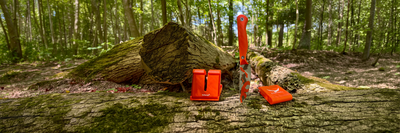
- A small field sharpener. Our UL Sharpener self-adjusts to blade angles from 11° to 21°, so touch-ups are quick.
- Game bags, gloves and cord. Not knives, but they make the knife work go a lot smoother.
Our recommendation: touch up your fixed blade before it gets really dull. A quick touch-up is a lot easier than bringing back an edge you've neglected.
After the Season: Kestrel For Life
When the season's over, send your knife home to us.
Every Kestrel knife is covered by Kestrel For Life: a lifetime warranty against defects and free lifetime sharpening. We sharpen, clean and tune it and ship it back, with free return shipping to U.S. addresses. Skeleton models sent in get a fresh paracord wrap, on us.
We'd rather you use your knife hard than worry about babying it.
Final Thoughts: Build the Setup Around Your Hunt
There's no single best knife for elk hunting for everyone.
A hunter driving logging roads has different needs than someone ten miles in with everything on their back.
But if you're asking us, here's what we'd focus on:
- A fixed blade with enough edge for the quarters and backstraps.
- A precise, sharp tool for the hide and detail work.
- An edge that lasts through the entire animal.
- A grip you trust when your hands are wet and cold.
- A setup light enough that you never think about leaving it behind.
- A plan for keeping it sharp, in the field and after the season.
Get those right, and you'll have a knife setup that earns its place in your pack.
Kestrel is veteran-owned, our knives are made in the USA, and we've been building them for hunters since 2011. Helping you figure out what to carry is part of the job, and we're always happy to help.
Questions? Contact us or email sales@kestrelknives.com.
— Team Kestrel

Related guides: Knife Model Comparison Guide · MagnaCut for Hunting Knives · How to Choose a Caping Knife