



Not every hunting knife is a good caping knife.
You can get through a lot of field dressing and processing with a traditional hunting knife. But when it's time to work around the eyes, ears, lips, and nose of an animal you're planning to mount, things get a little more complicated.
One wrong cut can damage a cape you've worked hard to bring home.
That's why I believe a dedicated caping knife deserves a place in a hunter's pack, especially if you're serious about preserving your trophy.
But what actually makes one caping knife better than another?
Let's break it down.
1. Blade Size Matters More Than You Think
One of the biggest mistakes is assuming a larger blade is more useful.
For caping, it's often the opposite.
You're making small, controlled cuts in tight areas. A large blade can get in the way, especially when you're working around an eye socket or separating delicate tissue.
You want a blade that allows you to choke up close to the cutting edge and maintain precise control.
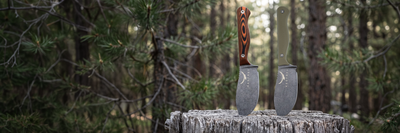
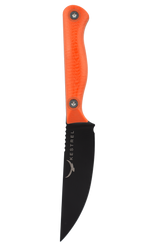
That's one reason we designed the Mountain Caper 2.0 the way we did.
It's compact, easy to maneuver, and weighs just 19.5 grams (knife only, no sheath). You're getting a purpose-built knife without adding unnecessary weight to your hunting setup.
My recommendation: Don't choose a caping knife based on how impressive the blade looks. Choose one that feels natural when making small, controlled movements.

2. Pay Attention to the Tip and Blade Geometry
A caping knife needs more than a sharp edge.
The shape of the blade matters just as much.
When you're working around the eyes, nose, or ears, you need a fine point that allows you to make precise cuts without removing more material than intended.
The Mountain Caper 2.0 features a refined blade profile with a smooth, flowing cutting edge.
This helps when you're following natural curves rather than making long, straight cuts.
Here's what I look for: A fine, controllable tip, a smooth cutting edge, and a blade shape that doesn't fight you when making detailed cuts.

3. Grip and Control Are Everything
This is something that doesn't get enough attention.
A knife might feel great when you're holding it in the shop, but that's not necessarily how it's going to feel when your hands are cold, wet, or covered in blood.
And when you're working around delicate areas, losing control isn't an option.
That's why grip and finger placement are so important.
On the Mountain Caper 2.0, we made several improvements to the jimping and finger choil.
The jimping is deeper and more pronounced, giving your fingers additional traction where you actually need it.
These might seem like small details, but they're the kinds of things that can make a difference when you're using a knife in the field.
My recommendation: Look beyond the handle material. Pay attention to where your fingers naturally rest and how much control you have when choking up on the blade.
4. Choose a Steel That Can Hold an Edge
A sharp knife makes detailed work easier.
A dull knife forces you to apply more pressure, which is exactly what you don't want when working around the eyes or other delicate areas.
For that reason, edge retention should be a serious consideration when choosing a caping knife.
We use CPM MagnaCut steel in the Mountain Caper 2.0 because it offers an excellent combination of edge retention, toughness, and corrosion resistance.
Those properties are particularly valuable in a hunting knife that may be exposed to moisture, blood, and changing weather conditions.
But even the best steel eventually needs sharpening.
That's why proper maintenance matters just as much as the steel itself.
If you'd like to learn more, check out our MagnaCut Hunting Knife Guide.

5. Don't Overlook Sharpening and Maintenance
This is one of those things that's easy to overlook when buying a knife.
Eventually, every knife needs to be sharpened.
A well-designed sharpening choil makes it easier to maintain the full cutting edge without leaving an uneven section near the handle.
We refined the sharpening choil on the Mountain Caper 2.0 to make maintenance easier and improve the transition into the cutting edge.
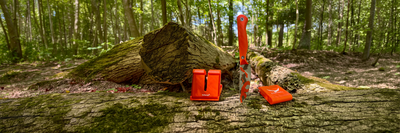
And when it's time for a proper sharpening, we've got you covered.
Through our Kestrel For Life Program, we offer free lifetime sharpening and maintenance, including free return shipping within the United States.
We want our customers using their knives, not worrying about maintaining them.
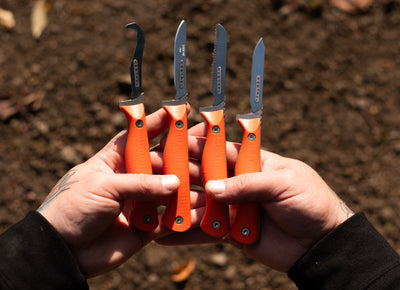
If you'd rather use replaceable blades, our Mountain Scalpel and Ovis Scalpel are also worth considering. Which scalpel blade for which job covers when to reach for a 60A versus a 70A.
6. Weight Matters, but So Does Function
If you're hunting sheep, mountain goats, or heading deep into the backcountry, every ounce matters.
But there's a balance.
Making a knife lighter doesn't automatically make it better.
You still need enough control, a useful blade shape, and a secure way to carry it.
At just 19.5 grams (knife only, no sheath), the Mountain Caper 2.0 is designed to add very little weight to your pack while remaining a practical tool for detailed work.
Its Kydex sheath provides secure retention while keeping the overall setup compact.
My recommendation: Don't chase the lowest weight at the expense of usability. The goal is to carry the lightest tool that still does the job well.

Do You Really Need a Dedicated Caping Knife?
Not everyone does.
If you're primarily processing meat and have no plans to preserve a cape, a versatile hunting knife might be all you need.
But if you're preparing an animal for a shoulder mount, a smaller, more precise knife can make the job significantly easier.
Personally, I like the idea of pairing a dedicated caping knife with a more versatile fixed blade.
For example, our Ovis Hunter 2.0 handles general field dressing, skinning, and processing, while the Mountain Caper 2.0 is better suited for the delicate work.
Each knife has a purpose, and you're not asking one blade to do everything.
You can also explore our Knife Model Comparison Guide to see how the different models compare.
Final Thoughts: Buy the Knife That Fits Your Hunt
There's no single hunting knife that's perfect for everyone.
What works for someone hunting whitetails close to home might not be the best choice for a hunter spending ten days in the mountains.
When choosing a caping knife, I'd focus on a few things:
- A compact blade that's easy to control.
- A fine tip for detailed work.
- Secure grip and well-placed jimping.
- Quality steel with good edge retention.
- Easy sharpening and maintenance.
- Low weight without sacrificing function.
Get those things right, and you'll have a knife that earns its place in your pack.
If you're considering the Mountain Caper 2.0 or have questions about which Kestrel knife makes the most sense for your hunting style, reach out.
I'm always happy to help.
— James
Shop Kestrel Ultralight Hunting Knives →
Related guides: Knife Model Comparison Guide · Best Knife for Elk Hunting · MagnaCut for Hunting Knives